

This quarter’s review explores the midterm elections, AI’s growing economic impact, and bond market volatility, with perspective on how investors can navigate political uncertainty and higher interest rates.
Ballots& Bedlam: Taking Stock of Midterm Elections and Bond Market Volatility
Executive Summary
Will Republicans remain in control of Congress in the closely contested midterm elections? Regardless of the results, investors should avoid overemphasizing election outcomes when making portfolio decisions. History shows markets have often performed well after midterm elections as political uncertainty fades. Instead, economic growth, corporate earnings, and valuations tend to play a much larger role in long-term returns than which party controls Washington. In this newsletter, we look at this historical data as well as growing public concern around AI and data center development—an issue drawing attention across the political spectrum.
In the markets, investors focused much of their attention this quarter on rising U.S. Treasury yields, growing government debt and deficits, and what those trends could mean for bonds. While the U.S. faces long-term fiscal challenges, recent bond market volatility reflects expectations for stronger economic growth rather than a loss of confidence in U.S. government debt. With Treasury yields at their most attractive levels in years, bonds once again offer meaningful income, greater diversification benefits, and a more compelling investment opportunity than they have for much of the past decade.
Midterm Math: History Suggests an Uphill Battle for the Party in Power
Election forecasting is imperfect, but we believe the evidence currently suggests that Republicans are likely to lose the House in November. That view is not based on any single poll, but rather on a remarkably persistent historical pattern. Since 1934, the sitting president’s party has lost House seats in 20 of 23 midterm elections, with an average loss of 27 seats. The trend has held under both Republican and Democratic presidents, as voters use midterms to check the party in power.
Republicans also face a lingering war in Iran, higher gasoline prices, and growing public concern surrounding AI and data center development. President Trump’s approval rating has also declined, while some recent polling favors Democrats. Together, these factors reinforce what historical precedent already suggests: Republicans face an uphill battle to maintain unified control of Congress.
Interestingly, the races appear more competitive than earlier expectations implied. Redistricting efforts have improved the GOP’s outlook in several key House districts, and voter registration trends have generally moved in Republicans’ favor since 2024. Because most congressional seats are considered safely Democratic or Republican, control of the House likely will be decided by about two dozen competitive races. Regardless of the outcome, analysts expect the majority to be slim.
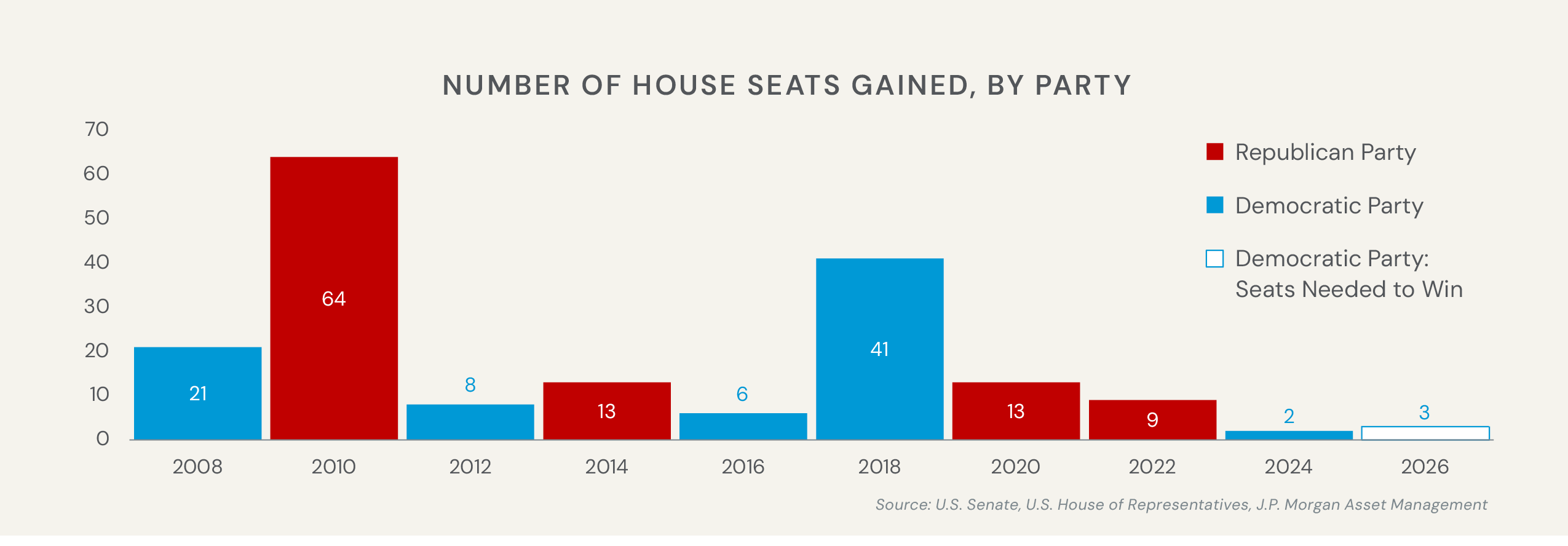
The Senate presents a different picture. While Democrats’ odds have improved in recent months, we expect the GOP will ultimately retain its majority. To take control of the upper chamber, Democrats need a net gain of four seats, and several of the races that could determine the majority are in states where Republicans have performed well in recent elections, such as Ohio, Texas, Iowa, North Carolina, and Alaska. As a result, the path to a Democratic Senate majority appears considerably narrower than in the House.
For investors, the more important takeaway is that elections historically have had far less impact than many fear. Markets in midterm years often experience heightened volatility leading up to Election Day as uncertainty surrounding policy and political control builds. However, markets typically rebound once the uncertainty recedes. In the postwar period, the S&P 500 has delivered positive total returns 100% of the time in the six- and twelve-month periods following a midterm election. While election outcomes can influence taxes, regulation, trade, and policy, over longer periods, economic growth, corporate earnings, interest rates, and valuations have mattered more than politics.
Policy Impact
Looking ahead, policy implications will vary depending on the makeup of Congress. A Republican-controlled government would likely support additional defense spending and continued deregulation efforts. A divided government, by contrast, could lead to greater legislative gridlock, a higher risk of government shutdowns, and greater reliance on executive actions. Trade policy is expected to remain a prominent issue regardless of the outcome, as the administration retains significant authority to implement tariffs.
If gridlock slows progress on domestic priorities, we expect the administration to place a greater emphasis on foreign policy, where the executive branch retains greater policy flexibility. At the same time, growing public concern around AI may force lawmakers to respond, increasing the potential for bipartisan action on safeguards and regulation.
As the saying goes, political opinions are best expressed at the polls, not in a portfolio. Investors who let politics override discipline risk undermining long-term returns. Factors such as economic growth and valuations have historically been more reliable indicators of future market performance than political policies.
NIMBY: AI Introduces Midterm Complications
Artificial intelligence is likely to leave its mark on the upcoming midterm elections. While economic conditions remain a primary driver of voter behavior, growing concerns surrounding AI and data center development have emerged as meaningful political issues. Many Americans remain skeptical of AI’s rapid expansion, citing potential job displacement, disruption to daily life, and the broader societal implications of emerging technologies. Opposition to data center construction has also intensified, with residents raising questions about electricity and water consumption, noise levels, and environmental impacts.
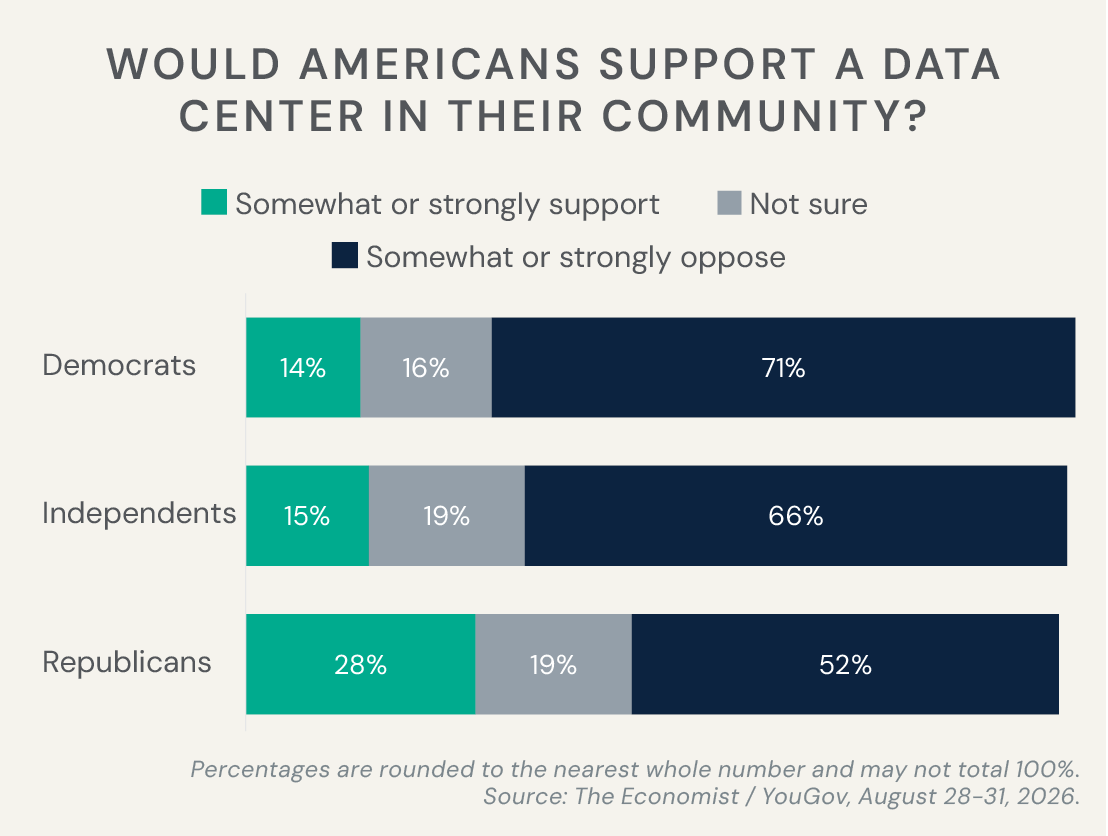
For Republicans seeking election, the politics are particularly delicate. These candidates must balance support for one of the administration’s key priorities with voters’ concerns about AI’s rapid expansion and rising costs.
These competing interests have created unusual political divisions that do not fall neatly along party lines. While President Trump and other supporters have championed AI and data center investment as critical to maintaining U.S. competitiveness, lawmakers from both parties have expressed reservations about the pace of AI growth and the need for additional safeguards. The issue has even started to influence local elections and development decisions, including a first-of-its-kind referendum against data center development in Wisconsin and the cancellation of a major project in Virginia following community opposition.
Encouragingly, both policymakers and the technology industry have begun supporting measures intended to shift more infrastructure costs to data center operators rather than consumers. These efforts reflect an understanding that AI’s long-term success may depend as much on public acceptance as technological advancement.
In September, Congress considered a bipartisan Ratepayer Protection Act, which seeks to shield consumers from potential energy costs associated with data centers. The bill passed the House with overwhelming support before stalling in the Senate, as Democrats raised concerns that it does not go far enough to force data center companies to foot the energy bill.
AI’s Labor-Market Impact Remains Limited
Beyond concerns about data center buildout, many Americans worry that AI could rapidly displace human workers. So far, however, evidence of widespread labor-market disruption remains limited. Data from the Federal Reserve Bank of St. Louis show the share of workers using AI rose from 28.2% in 2024 to 39.2% by mid-2026. Yet, employment has remained relatively stable in occupations often viewed as vulnerable to automation, including call center and IT support and travel-related roles.
The impact of AI, at least for now, may be appearing in more subtle ways. Research from Apollo Global Management suggests that wages have grown more slowly in occupations with greater exposure to AI, even as employment has remained relatively stable. One possible explanation is that employers are capturing some of AI’s productivity gains through slower wage growth rather than reducing their workforce. Other studies have found weaker employment trends among younger workers in AI-exposed occupations, though broader labor-market shifts may also be contributing, including the rise of remote work, which can make training and mentoring early-career employees more challenging.
Although it is still early, we continue to believe fears of widespread AI-driven job losses are overstated. We expect AI is more likely to augment human labor than replace it outright. History suggests technological advancements often lower costs, increase productivity, and create new sources of demand, ultimately supporting economic growth and employment.
Our Thoughts on Recent Bond Market Volatility
One of the most common questions we receive centers on growing federal debt and deficits and what they mean for U.S. Treasury yields, fixed income markets, and the broader investment landscape. While we share concerns that the U.S. is on an unsustainable long-term fiscal path, we do not believe a fiscal crisis is imminent. The U.S. retains significant advantages, including its role as issuer of the world’s reserve currency, deep and liquid capital markets, and multiple policy tools available to address fiscal pressures. Policymakers have a range of options available, from tax and entitlement reforms to changes in monetary and regulatory policy that could help stabilize the trajectory over time. The U.S. also continues to compare favorably with other major economies, particularly given the lack of a clear alternative reserve currency and the fiscal challenges facing many other developed nations.
Importantly, Treasury yields are influenced by more than just market concerns about government debt. Bond yields reflect a combination of inflation expectations, economic growth expectations, and credit considerations. While longer-dated securities such as the 30-year Treasury can be more sensitive to fiscal concerns, much of the Treasury curve remains heavily influenced by expectations for economic growth and inflation. Yields can therefore rise as the economic outlook improves, even without increased concern about the government’s ability to repay its debt.
Notably, today’s 10-year Treasury yield sits above estimates for long-run nominal economic growth, suggesting investors are being compensated for lending capital rather than accepting the unusually low yields that characterized much of the previous decade. That distinction helps explain much of the bond market’s behavior over the past year. While higher yields have created a frustrating environment for bond investors, the increase has been driven largely by stronger growth expectations and higher real interest rates rather than deteriorating confidence in U.S. Treasuries. Real Treasury yields are near their highest levels in two decades, providing investors with meaningful inflation-adjusted income that was largely unavailable throughout the 2010s. In addition, inflation expectations remain relatively well anchored, suggesting the recent rise in yields reflects improved real return opportunities more than fears of runaway inflation.
Equally important, the Treasury market is not exhibiting many of the warning signs we would expect to see if investors were broadly losing confidence in U.S. government debt. The yield curve has normalized, term premiums remain relatively stable, and Treasury auctions continue to attract healthy demand from both domestic and foreign buyers. In fact, recent 10- and 30-year Treasury auctions recorded some of the strongest demand metrics in years. Taken together, these indicators suggest markets are adjusting to a higher-growth, higher-rate environment rather than signaling an impending fiscal disaster.
Higher Yields Make Bonds More Attractive
Higher yields have also restored one of fixed income's most important portfolio benefits: diversification. During periods of economic weakness, Treasury bonds have historically provided positive returns while equities struggled. That relationship broke down in 2022 because inflation―rather than growth―was the primary shock facing investors, forcing the Federal Reserve to increase rates sharply.
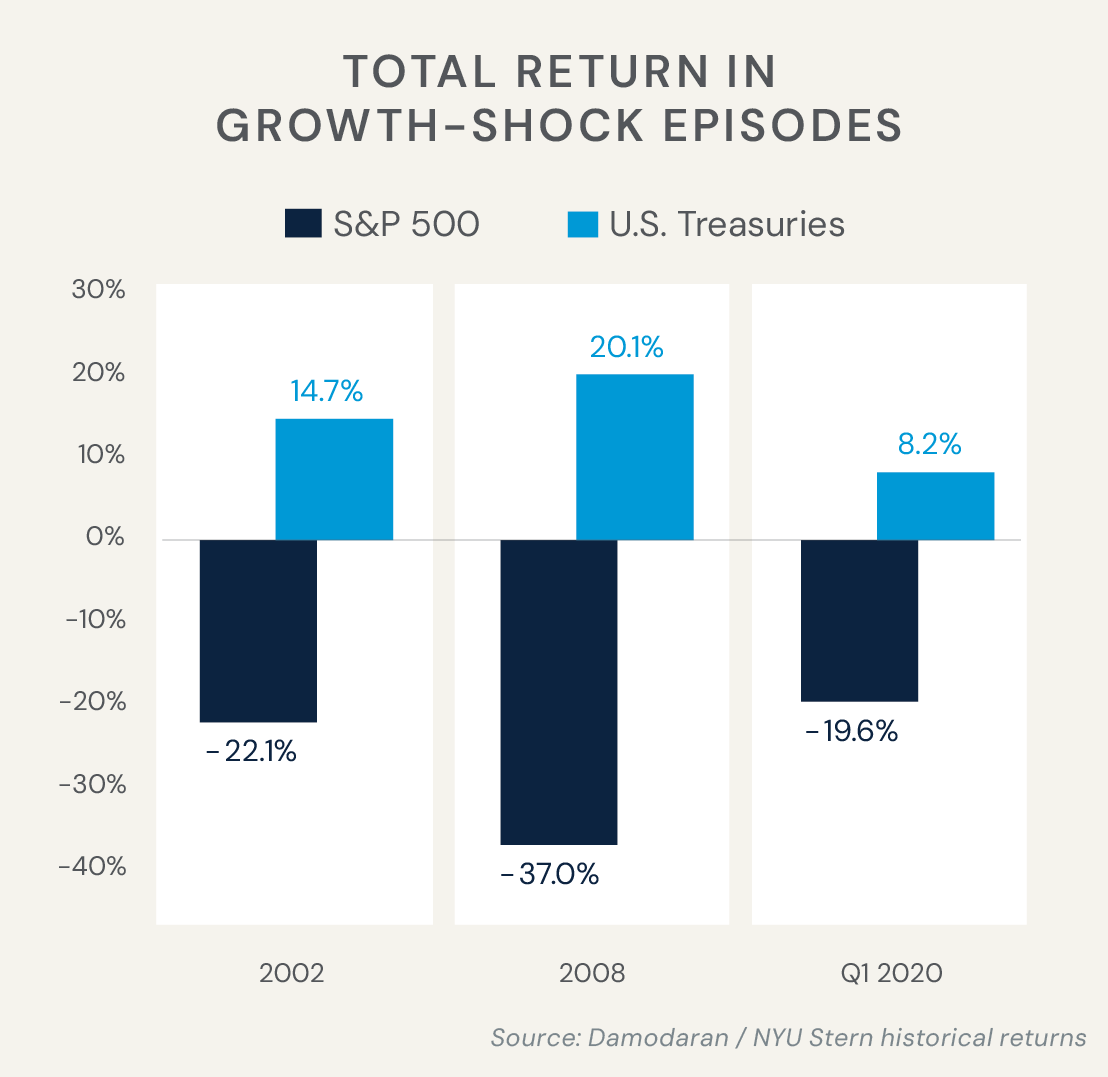
Today, however, starting yields are significantly higher than they were several years ago, giving bonds far more room to appreciate if economic growth slowed unexpectedly. As a result, fixed income can again provide meaningful ballast in diversified portfolios during periods of economic stress.
From an investment perspective, higher yields are not entirely negative. While rising rates can create short-term mark-to-market losses, they also improve the forward-looking return opportunity for fixed income investors. New bond purchases and reinvested cash flows can now be deployed at yields well above those available for much of the last decade. Additionally, current yield levels provide a larger cushion against future rate increases, meaning bonds can still generate respectable returns even if yields remain elevated or rise modestly from their current level.
Looking ahead, we continue to view fiscal deficits as a long-term risk that requires monitoring rather than a near-term threat likely to destabilize markets. Persistent deficits could contribute to higher interest rates, inflationary pressures, or a weaker U.S. dollar over time. These risks reinforce the importance of maintaining diversified portfolios that include assets capable of responding differently across economic environments.
For investors, we continue to believe fixed income plays an essential role within a diversified, time-based portfolio. While recent volatility has been challenging, today’s bond market offers something investors have not enjoyed for much of the past decade: attractive nominal yields, compelling real yields, and renewed diversification benefits. In our view, the recent rise in yields has ultimately strengthened the long-term case for bonds rather than weakened it.
Market Recap
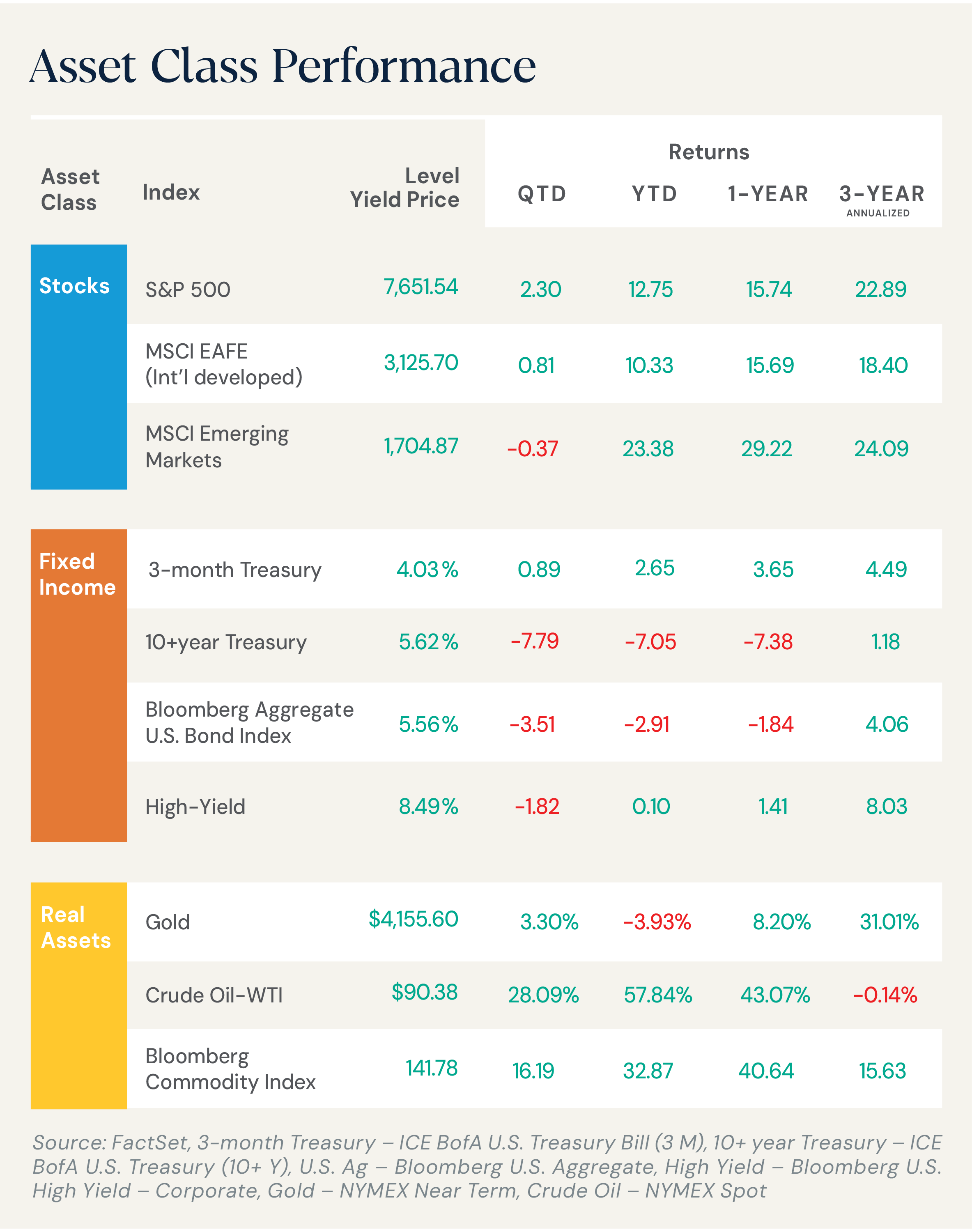
The third quarter was characterized by rising U.S. Treasury yields, heightened geopolitical uncertainty, and a more hawkish Federal Reserve. In September, the Fed raised interest rates for the first time since 2023, citing persistently elevated inflation. Renewed conflict in Europe and the Middle East added to inflation concerns and pushed oil prices to multi-month highs.
Despite the volatility, equities remained resilient, supported by strong corporate earnings and continued investment in AI. U.S. equities rose 2.3%, while developed international stocks gained 0.81% and emerging market stocks declined 0.37%.
Commodities were among the quarter’s strongest performers, surging 16.2% as escalating tensions in the Middle East drove oil prices higher. Gold gained 3.2%. Bonds, meanwhile, came under pressure as inflation concerns and expectations for higher interest rates pushed U.S. Treasury yields to their highest levels in more than two decades. The Bloomberg U.S. Aggregate Index fell 3.5%, while global bonds posted their worst quarterly performance since 2024.
Corporate earnings provided a bright spot. Approximately 86% of S&P 500 companies reported second-quarter earnings above estimates, the highest percentage since the second quarter of 2021. Energy led all 11 sectors with earnings growth of 146%. Looking ahead, analysts expect S&P 500 earnings growth to approach 30% for the third quarter, which would mark the index’s eighth consecutive quarter of double-digit earnings growth. According to FactSet, a record percentage of S&P 500 companies are also issuing positive earnings guidance for the third quarter, with Information Technology leading the way.
CAS00003124-09-26
Looking for personalized guidance?
Our advisors bring financial expertise and biblical wisdom together to guide the decisions shaping your future.