Trump Accounts: Where Do They Fit in Your Child's Financial Future?



Trump Accounts are a new planning tool that may help support your child's long-term financial future, but the right approach depends on your family's goals and overall financial plan.
Every generation sees new financial tools emerge. Some change the way families plan. Others simply add another option to an already robust toolbox.
The new Trump Accounts, created under the One Big Beautiful Act, fall somewhere in between.
Since its announcement, many parents have asked the same question: Should we open one?
A better question may be: How does a Trump Account fit into an overall plan for helping my child build a strong financial future?
Like any planning tool, the answer depends less on the account itself and more on the purpose you're trying to accomplish.
What Is a Trump Account?
Trump Accounts are a new tax-advantaged investment account available for children under age 18 who have a Social Security number. Children born between January 1, 2025, and December 31, 2028, may also qualify for a one-time $1,000 government contribution once an account is established and the required election is made.
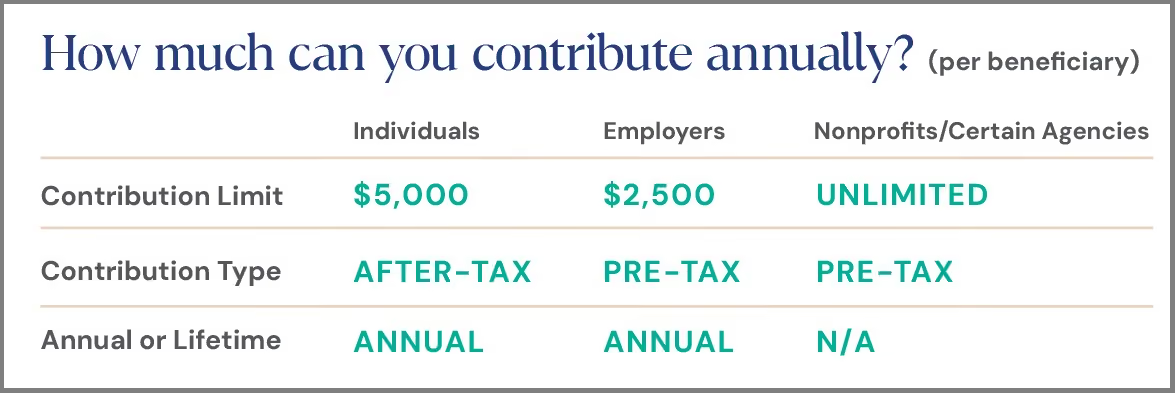
Parents, grandparents, and others can contribute up to $5,000 annually. Contributions are made with after-tax dollars, and investments grow tax-deferred. Employers can contribute $2,500, which counts toward the $5,000 cap but is excluded from the employee’s taxable income. The $1,000 government deposit does not count against the limit. During the growth period, investments are limited to low-cost U.S. stock index funds.
Unlike a custodial investment account, children generally cannot access the funds before age 18. At that point, the account begins operating under rules similar to a traditional IRA.
It's Not Just a College Savings Account
One of the biggest misconceptions is that Trump Accounts are simply another version of a 529 plan intended for educational expenses. They are not.
A 529 plan has one primary purpose: education. If the money is ultimately used for qualified education expenses, both the investment growth and withdrawals are generally tax-free.
Trump Accounts, however, were designed with a broader objective. After age 18, qualified withdrawals can avoid the early withdrawal penalty for certain expenses, including higher education, a first-time home purchase (up to applicable limits), and health insurance premiums during periods of unemployment. The account may also be converted to a Roth IRA under applicable rules, potentially giving a young adult an early start on long-term retirement savings. However, be sure to check applicable kiddie tax rules that may apply before a child turns 24.
The flexibility is one of the Trump Accounts’ greatest strengths—but it also means it serves a different purpose than a 529 plan.
Start with the Goal, Not the Account
Ask yourself what you're trying to accomplish. If your primary objective is paying for college, a 529 plan will generally remain the more tax-efficient solution because qualified education withdrawals are completely tax-free.
If your goal is giving your child a broader financial foundation, a Trump Account may deserve a place in the conversation.
It’s also important to realize that you do not have to choose one or the other. For many families, these accounts can work together.
Think Beyond College
One of the healthiest shifts in financial planning is recognizing that preparing children for adulthood involves more than paying tuition. Education is only one chapter of their financial story.
Helping a young adult purchase a first home, begin investing for retirement, or simply understanding the power of long-term investing may ultimately prove just as valuable as reducing their student loan debt.
Viewed through that lens, Trump Accounts expand—not replace—preparing children for a healthy financial future.
Wise Stewardship
Financial planning rarely comes down to finding the single "best" strategy. Instead, wise planning often involves understanding how different tools complement one another.
For many families, that may look something like this:
- Prioritize your own retirement savings first.
- Use a 529 plan for dedicated education funding.
- Consider a Trump Account as a way to help build your child's longer-term financial foundation.
- Teach your children how to become wise stewards.
- As your child grows, involve them in the planning process so they begin to understand not only how money works but why wise stewardship matters.
No single account or investment decision determines a child's future. The conversations you have, the habits you model, and the wisdom you pass along will likely have the greatest impact.
Trump Accounts represent one planning option for families. Used thoughtfully—and alongside other tools—they may help create opportunities that extend well beyond their educational years.
Reach out to a Blue Trust advisor to learn more about education planning and what may work best for your unique situation.
Looking for personalized guidance?
Our advisors bring financial expertise and biblical wisdom together to guide the decisions shaping your future.