When Geopolitics Meets the Market: Why This Time Feels Familiar
Financial markets have a long history of brushing off geopolitical events. Wars, elections, and diplomatic flare‑ups often dominate headlines, drive short‑term volatility, and then fade into the background as investors refocus on fundamentals. The question today is whether that pattern still holds as tensions with Iran push energy prices higher. So far, the answer appears to be yes.
Energy Prices and Inflation: A Real but Contained Pressure
The most immediate economic impact from the Iran conflict has been through energy markets. Higher oil and gasoline prices feed directly into inflation, raising the cost of living for consumers. That reality showed up clearly in April’s University of Michigan consumer sentiment survey, which fell to its lowest level on record. Respondents overwhelmingly cited higher gas prices and inflation as key concerns. On the surface, low sentiment is troubling, but consumer behavior is telling a more nuanced story.
Consumers Are Still Spending—Even If They’re Not Happy
Despite sour sentiment, consumer spending has remained remarkably resilient, even as income growth has slowed and gasoline prices absorb a larger share of household budgets. How is this possible?
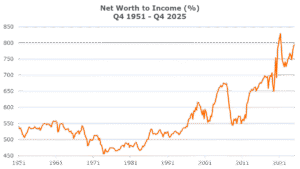
Part of the answer lies in savings. Households have been saving a smaller portion of their income in order to maintain spending levels. Importantly, aggregate household balance sheets remain quite strong, helping many consumers continue spending despite tighter budgets. Household net worth relative to disposable personal income is near an all‑time high.
Source: FRED
That backdrop has helped cushion the impact of higher prices on consumer behavior. And underpinning that household wealth? A very strong stock market.
Markets Look Through the War and Refocus on AI
Markets initially reacted to Iran‑related tensions with predictable anxiety: rising oil prices, falling stock prices, and higher volatility. But as is often the case, those fears proved temporary. The U.S. stock market recovered even as the conflict remains unresolved.
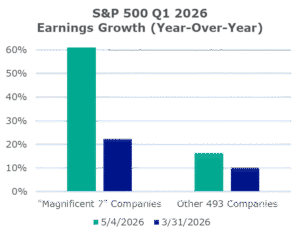
Following the ceasefire announcement on April 7, AI reasserted itself as the dominant narrative driving markets higher. Corporate earnings expectations have been revised upward, not because geopolitics faded into clarity, but because companies―particularly large technology firms―continue to benefit from a seemingly insatiable demand for AI.
Source: FactSet
Earnings matter more than headlines, and earnings momentum has been moving in the right direction. That trend has allowed markets to look past geopolitical risk and focus instead on growth opportunities.
The Bigger Picture
None of these insights suggest that geopolitical risks don’t matter. Energy shocks can derail inflation progress, pressure consumers, and force central banks to stay restrictive for longer. The Iran conflict is not resolved, and flare‑ups could still generate volatility.
However, history is repeating itself in an important way. Markets are acknowledging the risks without becoming consumed by them. Consumers are feeling the strain but continuing to spend. And investors are once again prioritizing long‑term drivers of value—most notably AI—over short‑term uncertainty.
Geopolitics may shake markets in the short term, but fundamentals ultimately decide direction over time. And at this moment, those fundamentals are still pointing forward.